Risk Management · 2025
In this section2 topics
Risk Management Policy & Plan
Main Introduction
Information and Communication Networks Public Company Limited ("the Company") recognizes that effective risk management is a crucial mechanism for driving the organization towards sustainability. The Risk Management Committee is therefore committed to adhering to the enterprise risk management framework, focusing on integrating risk management with business operating strategies to ensure that the Company can identify, assess, and manage both internal and external risks to an acceptable level (Risk Appetite), while also seeking new business opportunities to generate the best returns for shareholders and all stakeholders.
The Company's risk management comprises four key components to ensure operations adhere to good corporate governance principles and achieve organizational objectives, as follows:
Components of Risk Management
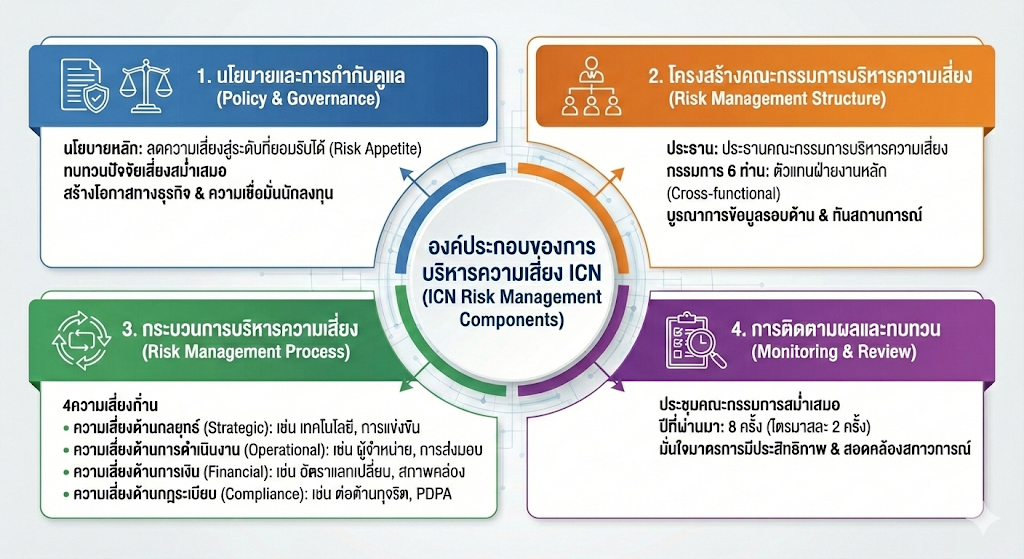 1. Policy & Governance
The Company recognizes the importance of managing risks from both internal and external factors. Its main policy is to implement measures to reduce risks to an acceptable level (Risk Appetite), coupled with regularly reviewing risk factors and obstacles that may affect the Company and its stakeholders, in order to create business opportunities and build investor confidence.
2. Risk Management Committee Structure
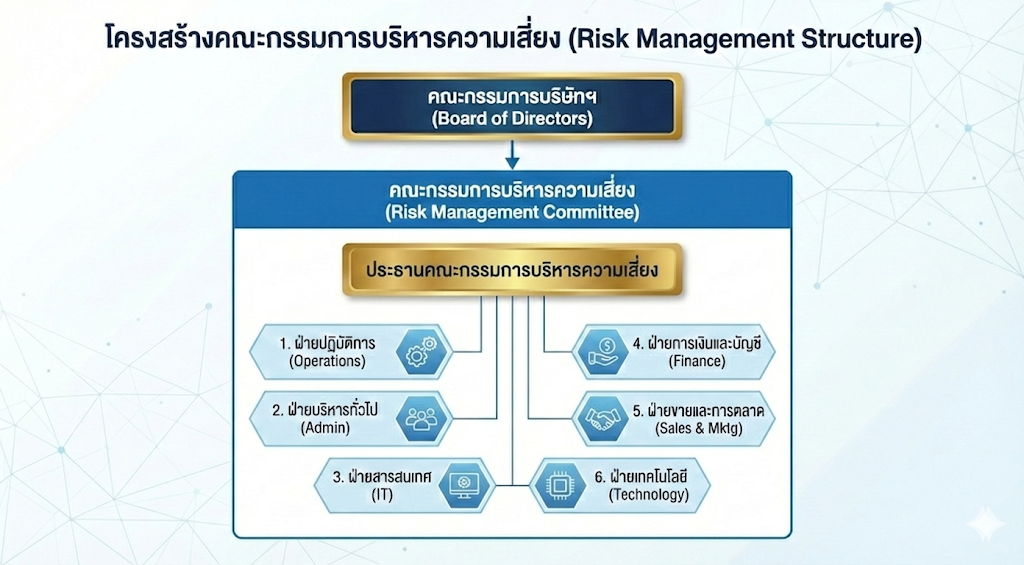
To ensure comprehensive and effective risk assessment and mitigation strategies, the Company has appointed a Risk Management Committee, with a term not exceeding 2 years, comprising 7 senior executives and representatives from key departments, as follows:
Chairman: Representative from the Board of Directors
Directors (6 persons): Representatives from Operations, General Administration, Information Technology, Finance and Accounting, Sales and Marketing, and Technology departments.
This structure facilitates the integration of data from all cross-functional departments, ensuring comprehensive and up-to-date risk analysis.
3. Risk Management Process
The Risk Management Committee is responsible for continuously monitoring, controlling, assessing, and measuring significant risks, covering four main types of risks, namely:
Strategic Risk: e.g., technological changes, competition
Operational Risk: e.g., vendor reliance, work delivery
Financial Risk: e.g., exchange rates, liquidity
Compliance Risk: e.g., anti-corruption, PDPA law
4. Monitoring & Review
The Company mandates regular meetings of the Risk Management Committee to consider and review the risk status. In the past year, a total of 8 meetings were held (2 meetings per quarter) to ensure that the established risk management measures are effective and consistent with changing circumstances over time. The Risk Management Committee regularly reports the results of risk management, key risk indicators, and risk management approaches to the Board of Directors every quarter, to ensure that the Board of Directors is continuously informed and can effectively oversee the organization's risk management in accordance with established goals and policies.
Policy & Plan Description
Risk Management Policy
Risk management requires cooperation from personnel at all levels. Therefore, risk management is designated as the responsibility of employees at every level, who must be aware of the risks inherent in their work. Emphasis is placed on managing various risks to an appropriate and acceptable level.
Establish an organizational risk management process that adheres to good standards and international best practices to ensure efficient management of risks that may impact the Company's operations. This fosters development and consistent risk management practices, integrating the risk management system into decision-making, strategic planning, operational plans, and the execution by management and employees, while focusing on achieving defined objectives, goals, vision, mission, and strategies to create operational excellence and build confidence.
Establish guidelines for preventing and mitigating operational risks of the Company to avoid potential damage or losses, including regular monitoring and evaluation of risk management. Information technology systems are utilized in the Company's risk management process, and personnel at all levels are supported to access risk management information comprehensively, as well as to establish an efficient risk management reporting system for management and internal auditors.
The Company's risk management will be integrated with business planning and corporate strategy. All operational processes must undergo risk consideration to ensure that potential obstacles and impacts hindering the Company's objectives are systematically and efficiently managed, following the process below:
Risk Mitigation Plan
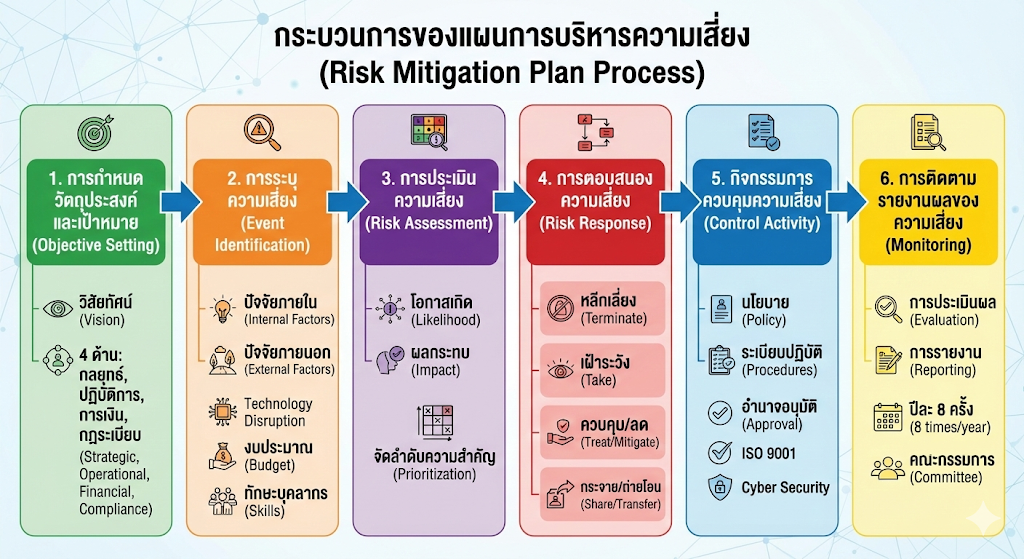
1. Objective and Goal Setting
The Company sets risk management objectives in alignment with its vision of being a "leader in integrated digital infrastructure," categorized into four areas:
Strategic: To ensure the expansion of new businesses into the Data Center, AI Solutions, and related markets aligns with the goal of creating a New S-Curve.
Operational: To ensure the timely delivery of Turnkey projects and maintenance work according to quality standards.
Financial: To maintain liquidity, manage project costs, and reduce revenue volatility through generating recurring income.
Regulatory (Compliance): To ensure operations comply with business laws, SET regulations, the Anti-Corruption Policy (CAC), and the Personal Data Protection Act (PDPA).
2. Event Identification
The Company will identify the causes or risk factors by considering ICN's specific context, including both internal and external factors, such as:
External Factors: Rapid technological changes (Technology Disruption), delays in government budgets, volatility of the Thai Baht exchange rate for equipment imports.
Internal Factors: Personnel readiness for new technologies (AI Skill), efficiency in managing sub-contractors.
3. Risk Assessment
Consider the likelihood and impact on business objectives, prioritizing risks. For example, risks with high impact on core revenue or organizational reputation will be classified as "urgent risks" requiring immediate management.
4. Risk Response
The Company defines four risk management strategies tailored to different situations, as follows:
Avoidance: Cease or avoid activities with risks exceeding the acceptable level (Risk Appetite), such as refusing to commence work or place advance orders if the client has not issued a clear Letter of Intent (LOI).
Monitoring and Acceptance: Accept unavoidable risks or those worth investing in, such as competition in the bidding market. The Company will monitor this by closely tracking competitor news and technology.
Control and Mitigation: Implement measures to reduce likelihood or impact, such as:
Mitigating Supply Chain risks: Implement a Multi-Vendor Strategy to prevent product shortages.
Mitigating revenue risks: Expand service offerings to increase recurring income.
Mitigating contractor risks: Utilize the SORT VENDOR database system to screen for quality contractors.
Share / Transfer: Transfer risks to third parties, such as entering into Forward Contracts to lock exchange rates, obtaining project damage insurance, or outsourcing certain tasks to specialists.
5. Risk Control Activities
Establish concrete policies and procedures for risk control, such as defining authorization limits, conducting credit checks for new customers or partners, and adhering to ISO 9001 standards and cybersecurity standards, to ensure that implemented measures are effectively put into practice.
6. Risk Monitoring and Reporting
The Company continuously monitors and evaluates risk management performance. The Risk Management Committee holds meetings at least 8 times per year To review the status of Key Risk Indicators (KRIs) and update the risk management plan for real-time monitoring, as well as report results to the Board of Directors to ensure sustainable achievement of objectives.
Operations of the Risk Management Committee
In 2025, the Risk Management Committee strictly adhered to its charter, holding a total of 8 meetings to closely monitor key risk indicators (KRIs), particularly in information technology risks, sustainability risks (ESG Risk), and risks from new business expansion. The Committee provided recommendations and established proactive risk response measures for management to implement concretely.
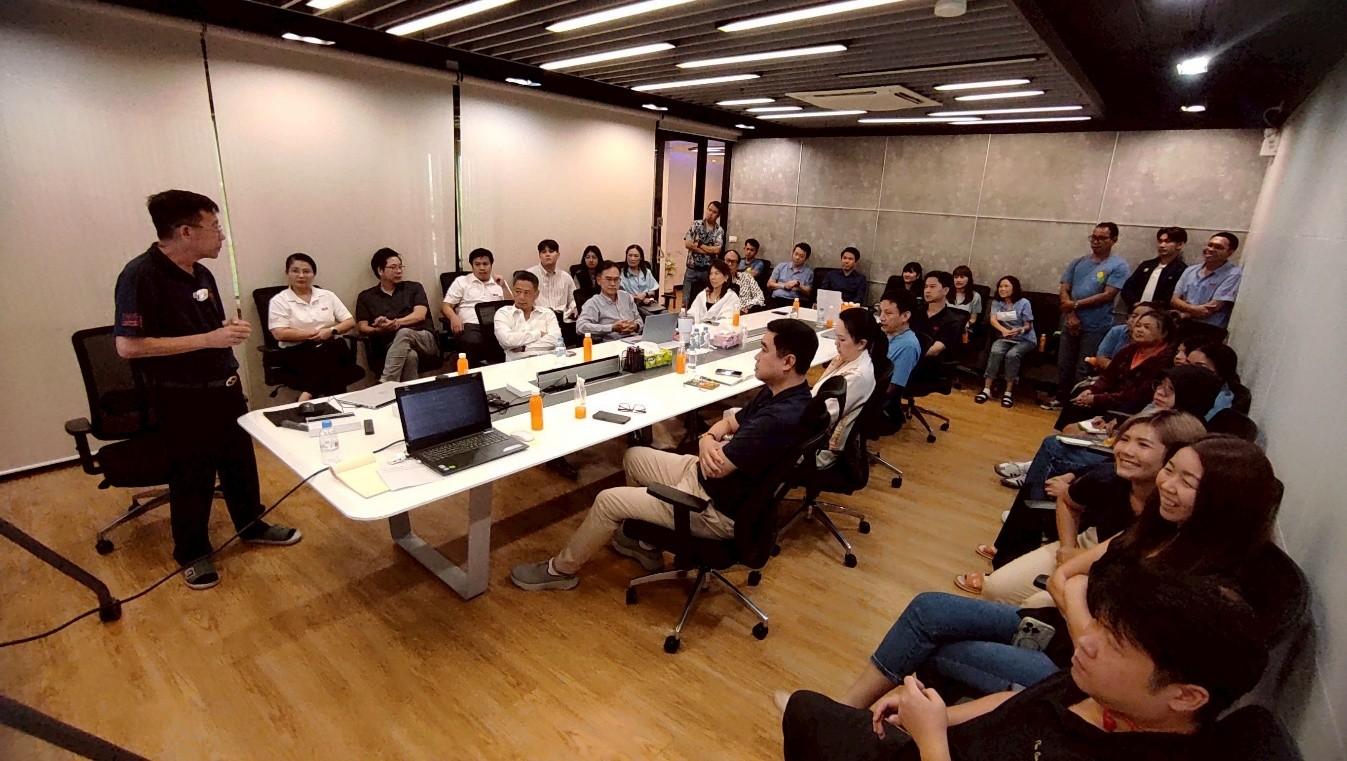
Furthermore, the Committee emphasizes fostering a risk culture and the participation of personnel at all levels, thus utilizing the opportunity in the activity "ICN Grow Together" (Internal communication activity in Town Hall format) 11th session for Q3 2025 on Friday, August 29, 2025, by Chairman of the Risk Management Committee had the honor of lecturing on organizational risk management, addressing risk issues gathered from Employee Opinion Survey (Risk Survey) to communicate and exchange perspectives, ensuring employees recognize the importance of real-world operational data and participate in monitoring new potential risks, thereby enabling the organization to grow stably and sustainably.
Policy Document Link
https://www.icn.co.th/a/download/file/231-E-04.pdf
Page Number in Report
195
Risks to the Company's Business Operations
Introduction
1. Strategic Risk Risks associated with the formulation of strategic plans, operational plans, and the improper implementation of such plans. Furthermore, strategic risks also include changes arising from external and internal factors that impact the formulation of strategies or operations, thereby affecting the achievement of the company's main objectives, goals, and operational guidelines.
2. Operational Risk Risks associated with the operations of each process or activity within the company, including risks related to the management of information technology data and various knowledge data, to ensure that operations achieve defined goals. Operational risks will impact the efficiency of work processes and the achievement of the company's overall main objectives.
3. Risks related to financial management (Financial Risk) This may include risks arising from internal factors, such as the management of expenditure planning according to municipal ordinances, or from external factors, such as budget allocation or the risk of counterparties failing to fulfill their agreed obligations, which could impact the company's existence and cause damage.
4. Compliance Risk Risks arising from non-compliance or deviations from laws, regulations, rules, professional standards, or operational guidelines related to the company's operations, which may result in legal penalties, fines by regulatory bodies, or damage to the company's credibility and reputation.
Risk Register
| Risk Name | Risk Characteristics | Consequences | Management Measures | Related Risk Factors |
|---|---|---|---|---|
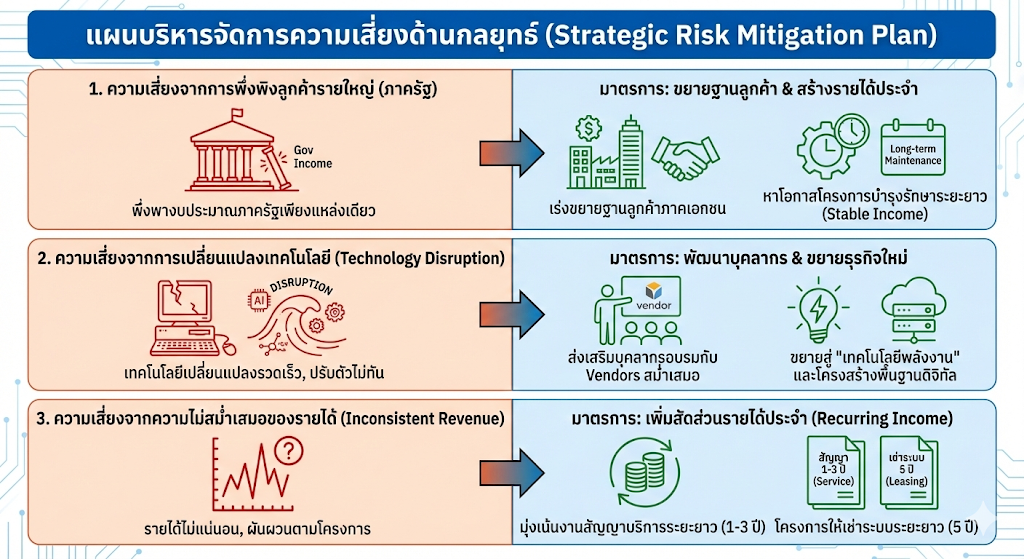
| Strategic Risk | 1. Risk from technological changes (Technology Disruption): The information technology and telecommunications industry is undergoing rapid and disruptive changes, particularly with the advent of Artificial Intelligence (AI), Cloud Computing, and 5G technology. This has led to a decrease in demand for traditional hardware devices and a shift towards greater use of software and platforms. Such technological leaps impact traditional service models. Therefore, the company has adjusted its strategy to become a leader in comprehensive digital infrastructure, expanding its business into the Data Center and AI Solutions markets to mitigate risks from reliance on older technologies and create a new S-Curve for the organization. 2. Risk from reliance on large customers: Although government clients remain a significant revenue base, the company has accelerated the expansion of its customer base to include private sector clients in the energy and industrial factory groups, as well as increasing the proportion of recurring income from maintenance work and Managed Services to stabilize cash flow and reduce sole reliance on government budgets. 3. Risk from revenue inconsistency (Revenue Volatility Risk): The nature of project-based business operations means that revenue recognition depends on the successful delivery of each installment and the volume of projects won in each year. This may lead to revenue inconsistency in some quarters, especially during the transition period between the completion of old projects and the commencement of new ones. If the company experiences a gap in receiving new projects or delays in project delivery, it will directly impact the overall annual performance. | 1. Technology Disruption Risk: Impact: Failure to adapt to AI, Datacenter, or 5G technologies will lead to a decrease in demand for traditional hardware equipment, resulting in a decline in revenue from existing businesses and a loss of competitiveness. 2. Reliance on large customers risk: Impact: Reliance on government budgets as the sole source of income poses a high risk to the company if budgets are delayed or government policies change, which would affect cash flow and overall performance. 3. Revenue Volatility Risk: Impact: Business operational liquidity and the company's overall performance | Summary of risk management measures for reliance on major customers ( Reliance on large customers):
Summary of risk management measures for technological changes (Technology Disruption):
Summary of risk management measures for revenue volatility (Revenue Volatility Risk):
Summary of Strategic Risk Management Plan
| 732 · Description: Changes in technologies · Info category: STRATEGIC_RISK · 734 · Description: Reliance on large customers or few customers · Info category: STRATEGIC_RISK · 737 · Other name: Risk of income inconsistency · Description: Other · Info category: STRATEGIC_RISK |
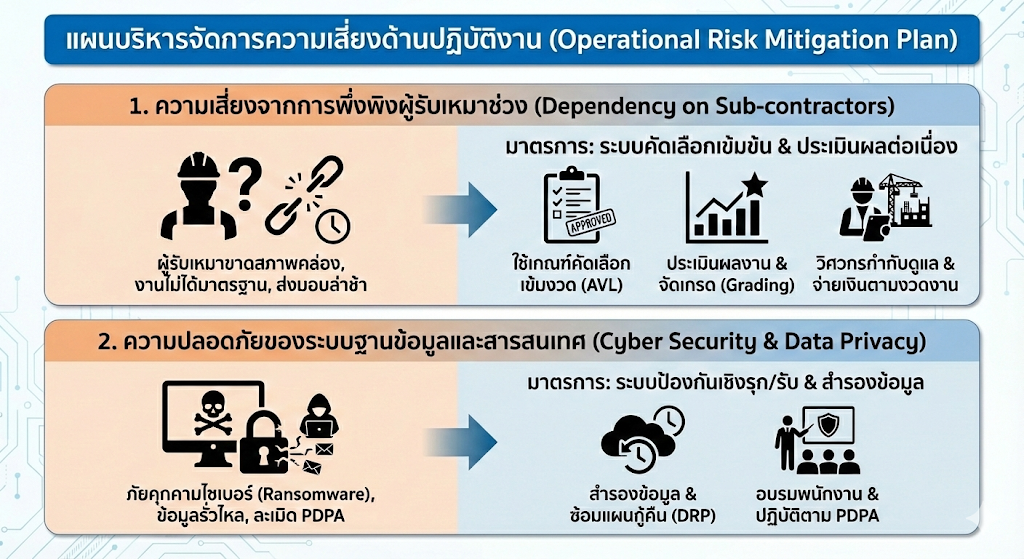
| Operational Risk | 1. Risk of Dependency on Sub-contractors (Dependency on Sub-contractors): In the implementation of large-scale projects covering nationwide areas, such as Fiber Optic network deployment, radio communication network deployment, or long-term equipment leasing, the company needs to manage resources for maximum efficiency. Therefore, specialized or site-ready sub-contractors are hired to carry out the work. If sub-contractors lack financial liquidity, face labor shortages, or deliver substandard work, it will directly impact the company's costs and reputation. 2. Risk of Database and Information System Security (Cyber Security & Data Privacy): In an era where the company is moving towards Data Center business and digital infrastructure, data is considered the most valuable asset, including trade secrets and personal data. (Current cyber threats are becoming more severe, such as Ransomware. If information systems are attacked, it will severely impact customer confidence and the organization's image. | 1. Risks from reliance on sub-contractors (Dependency on Sub-contractors): Impact: If sub-contractors lack liquidity or perform below standard, it will directly result in delayed project delivery, escalated project costs, and damage the company's reputation and credibility. 2. Risks related to database and information system security (Cyber Security & Data Privacy): Impact: Being attacked by Ransomware or data breaches will disrupt business operations, cause damage to digital assets, and severely impact the organization's reputation. | Summary of Risk Management Measures for Dependency on Sub-contractors:
Summary of Risk Management Measures for Database and Information System Security (Cyber Security & Data Privacy):
Summary of Operational Risk Management Plan
| 739 · Description: Shortage or reliance on skilled workers · Info category: OPERATIONAL_RISK · 755 · Other name: Database and Information System Security Risks · Description: Other · Info category: OPERATIONAL_RISK |
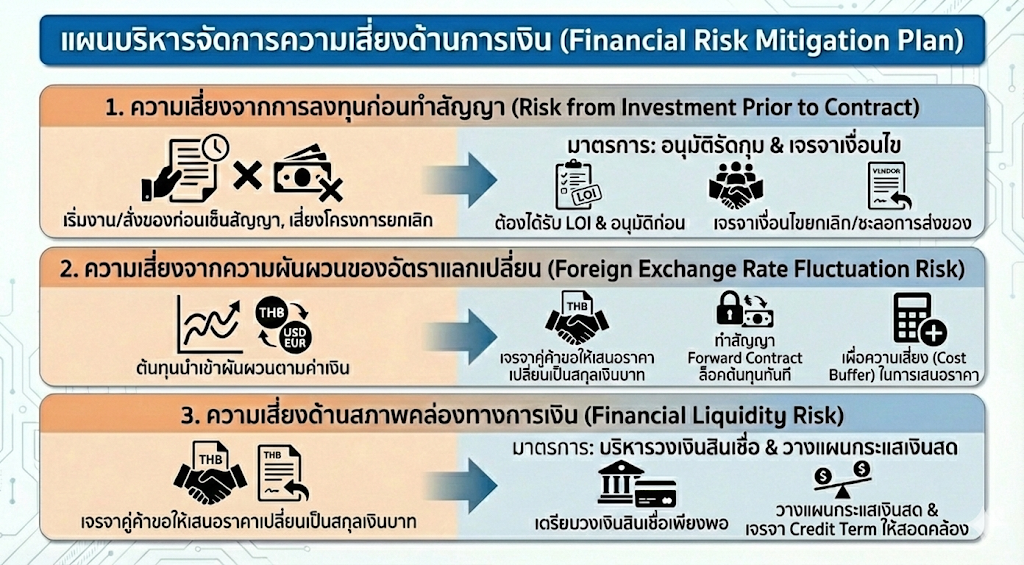
| Financial Risk | 1. Foreign Exchange Rate Risk: In some projects, the company is required to import information technology equipment or network infrastructure equipment from abroad, which is predominantly traded in US Dollars (USD) or Euros (EUR). Conversely, the company's primary revenue from service fees is received in Thai Baht. Uncontrollable fluctuations in foreign exchange rates may directly impact project costs and the company's gross margin, particularly for long-duration projects. 2. Financial Liquidity Risk: Operating large-scale projects, such as the construction of base stations or data centers, requires significant working capital for materials, equipment, and contractor fees. Meanwhile, payment collection from customers (especially government agencies) is typically milestone-based, requiring strict acceptance processes that can be time-consuming. Delays in work acceptance may lead to a cash flow mismatch, impacting the company's liquidity. 3. Risk from Providing Services or Ordering Equipment Prior to Contract Signing: In the highly competitive environment of telecommunication system installation contracting (Turnkey Project) business, the speed of project delivery is a crucial factor in gaining a competitive advantage. In some cases, the company may need to commence certain operations in advance, such as site surveys, system design, or ordering long lead time equipment, to meet customer deadlines. Such actions taken before the official signing of a contract carry inherent risks if the project is cancelled or if contract terms are subsequently altered, which could result in the company incurring sunk costs. | 1. Foreign Exchange Rate Risk: Impact: Importing equipment in USD/EUR while revenue is in Thai Baht leads to uncertain project costs and may erode gross margin if the Thai Baht depreciates. 2. Financial Liquidity Risk: Impact: Large-scale projects require high working capital. If government acceptance of work is delayed, a cash flow mismatch will occur, affecting payments to partners. 3. Risk from Providing Services or Ordering Equipment Prior to Contract Signing: Impact: If the project is cancelled or contract terms are subsequently changed, the company may have to bear the incurred costs (Sunk Cost). | Summary of Risk Management Measures for Providing Services or Ordering Equipment Prior to Contract Signing with Customers (Risk from Providing Services or Ordering Equipment Prior to Contract Signing):
Summary of Foreign Exchange Rate Fluctuation Risk Management Measures (Foreign Exchange Rate Risk):
Summary of Financial Liquidity Risk Management Measures (Financial Liquidity Risk):
Summary of Financial Risk Management Plan
| 764 · Description: Fluctuation in exchange rates, interest rates, or the inflation rate · Info category: FINANCIAL_RISK · 1724 · Description: Liquidity risk · Info category: FINANCIAL_RISK · 767 · Other name: Risk from service provision or equipment procurement before contracting with customers · Description: Other · Info category: FINANCIAL_RISK |
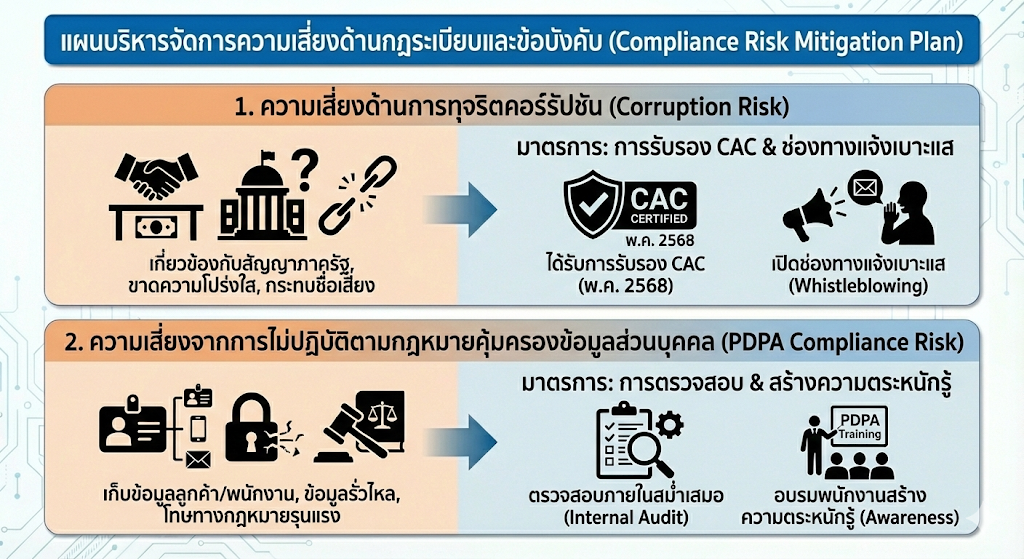
| Regulatory and Compliance Risk | 1. Risk of Non-compliance with Personal Data Protection Law (PDPA Compliance Risk): In the company's normal business operations, including turnkey projects, maintenance services, and internal organizational management, it is necessary to collect, use, and disclose personal data of various groups of relevant individuals, such as customer contact information (both public and private sectors), business partners, subcontractors, and a large number of internal employees. If the processes for storing and processing this data are not stringent, leading to data breaches or misuse without consent, it will be considered a violation of the Personal Data Protection Act (PDPA), which carries severe civil, criminal, and administrative penalties, and also impacts the organization's credibility. 2. Corruption Risk: As the company's core business involves bidding for projects and contracting with government agencies and state enterprises, which are groups with high risks regarding transparency and influence peddling, if the company lacks adequate control measures, actions that could lead to corruption might occur due to employees' inadvertence, or the company might be accused of involvement in bribery, which would severely impact its reputation, image, and status as a partner with government agencies. | 1. Risk of Non-compliance with Personal Data Protection Act (PDPA Compliance Risk): Impact: If the processes for collecting and processing this data are not stringent, leading to data breaches or unauthorized use for unintended purposes without consent, it will be considered a violation of the Personal Data Protection Act (PDPA), which carries severe civil, criminal, and administrative penalties, as well as impacting the organization's credibility. 2. Corruption Risk: Impact: As the company bids for government projects, if there is a lack of transparency or if it is accused of involvement in bribery, it will face legal penalties, be blacklisted, and lose future bidding opportunities. | Summary of Corruption Risk Management Measures:
Summary of Risk Management Measures for Non-Compliance with the Personal Data Protection Act (PDPA Compliance Risk):
Summary of Regulatory and Compliance Risk Management Plan
| 758 · Description: Violations of laws and regulations · Info category: COMPLIANCE_RISK · 760 · Other name: Corruption Risk · Description: Other · Info category: COMPLIANCE_RISK |